
Many times it is difficult to determine the amount of load or intensity an individual should perform a task with during the rehabilitation process. In both physical therapy and strength and conditioning we use a subjective, self-selected measurement that helps us determine how hard an individual is working.
This scale is called your “Rating of Perceived Exertion,” or RPE.
The RPE is literally your current, real time, rating of how hard you are working. You are rating your exertion level.
There are several different scales to determine this effort. The simplest and most practical one is the 1 to 10 scale. This is a common scale used in pain science, interest level, etc. The beauty of this scale is its simplicity and familiarity, as it is commonly used to gauge pain, interest levels, etc. see the info graphic below for how this applies to exercise intensity.
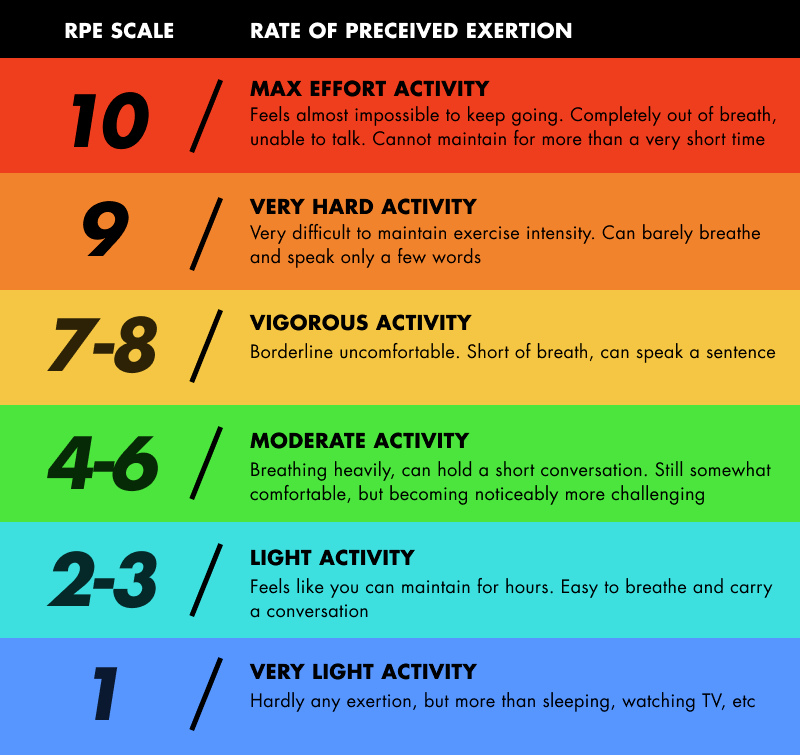
OMNI Perceived Exertion for Resistance Training
Typically the Borg RPE scales are designed to assess and athletes current state during cardiovascular fitness tests. In physical therapy and strength and conditioning, we are looking for more information both peri- and post-exercise sets with resistance training. We are more commonly apt to use what’s known as the OMNI perceived exertion of resistance training scale.
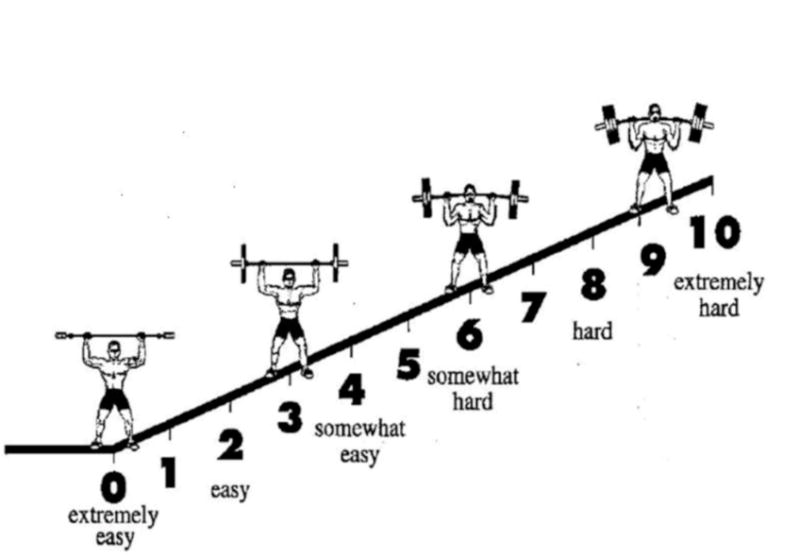
The OMNI-RES was developed by Robertson et al. as a substitute for the Borg RPE scales. Subjects are instructed to use a number from the scale to rate their overall muscular effort level, and the investigator asks the patient “How hard do you feel your muscles are working?” An anchoring procedure is included in which the subject assigns the perceived level of exertion associated with lifting a very light weight as ‘Extremely easy’ and the feeling of exertion associated with lifting a very heavy weight as ‘Extremely hard’. Subjects are then instructed to report their RPE at the end of RT using a number from the OMNI-RES (0–10) scale. On the scale, a score of 0 represents maximal rest (i.e., a seated position), and 10 represents a sensation of effort above that which the patient could feel during the session.
Morishita et al 2018
Borg Scale 6-20
Another way to measure RPE is through the classic Borg scale. This is a scale that is popular with exercise physiologists, and is more informative to the patient and clinician in terms of exertion level. This is a 15-point scale that ranges from 6 to 20, and the athlete indicates how hard they are working when cued by the clinician. This is a common scale used in VO2max tests, and other max effort tests, in the sports science setting.
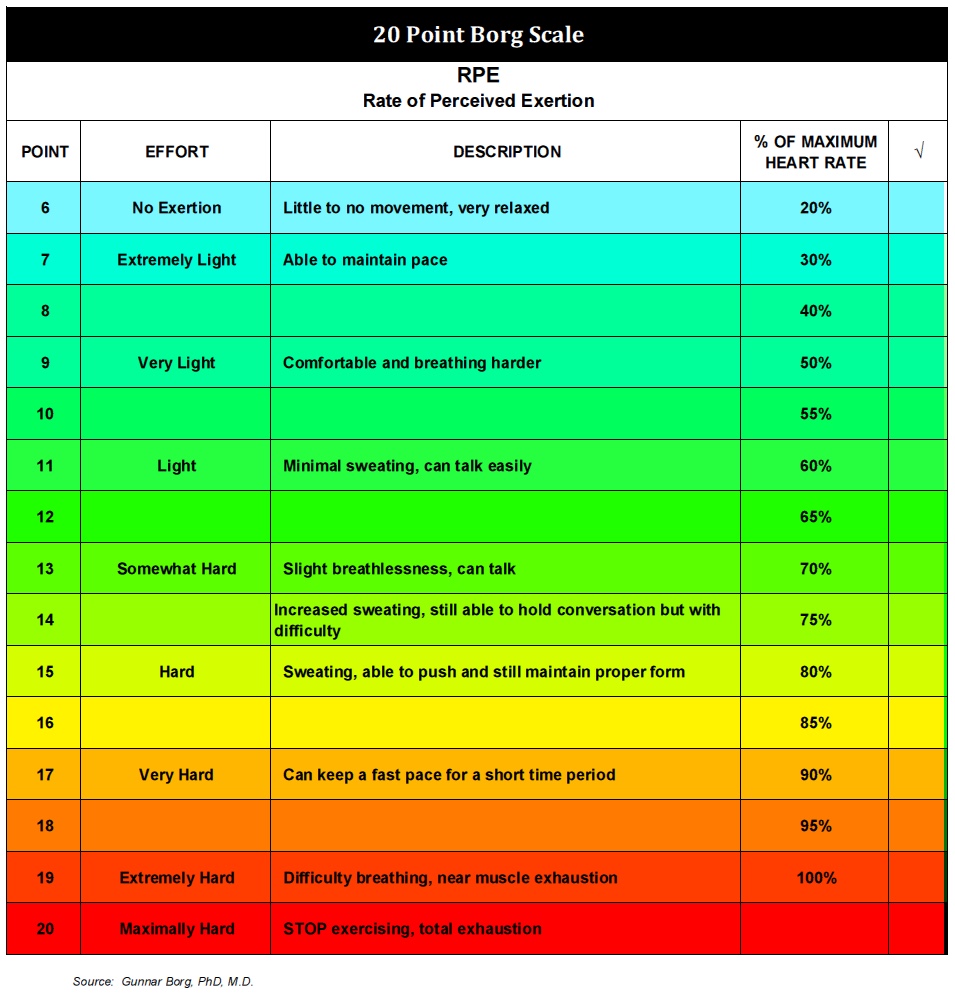
The Borg 15-point RPE scale was developed by Borg. The scale is a modified 6–20-point RPE scale. The Borg 15-point RPE scale is used to measure the level of physical strain or perceived exertion. The Borg 15-point RPE scale has been shown to be significantly correlated with heart rate. Moreover, this scale is considered a valid and inexpensive tool for monitoring exercise intensity. In clinical practice, patients are instructed to choose a number from the scale and rate their overall effort during resistance training (RT). A rating of 6 is considered to represent no exertion, i.e. rest, and a rating of 20 represents maximal exertion, i.e. the most stressful exercise performed.
Morishita et al 2018.
References:
- Borg G. Borg’s perceived exertion and pain scales. Human kinetics; 1998.
- Borg G. Perceived exertion as an indicator of somatic stress. Scand J Rehabil Med. 1970;2:92–98.
- Morishita et al. Relationship between the rating of Perceived Exertion Scale and the load intensity of resistance training. Strength Cond J. 2018 Apr;40(2):94-109.
- Robertson RJ, Goss FL, Aaron DJ, Gairola A, Kowallis RA, Liu Y, Randall CR, Tessmer KA, Schnorr TL, Schroeder AE, White B. One repetition maximum prediction models for children using the OMNI RPE Scale. J Strength Cond Res. 2008;22:196–201.


Leave a Reply